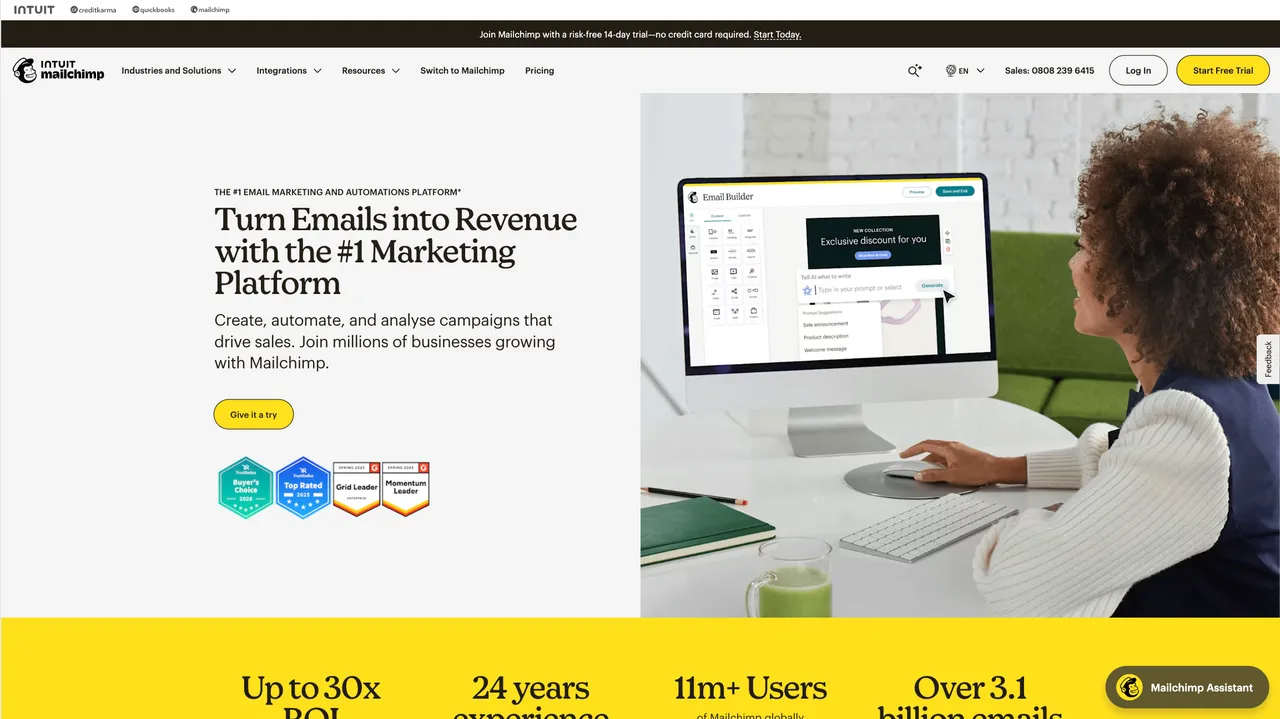
Mailchimp
Mailchimp is a mature email marketing platform for newsletters, ecommerce, automations, landing pages, segmentation, and reporting. It is powerful, but not always the leanest choice for newsletter-first creators.
WebsiteMailchimp is one of the best-known email marketing platforms in the world. For a long time, it was the default answer when a small business asked, “Where should I send my emails?” That history still matters: Mailchimp has deep templates, reliable campaign tools, strong integrations, and enough automation power for serious marketing teams.
For newsletter operators, the question is not whether Mailchimp is capable. It is whether it is the right shape. Mailchimp is built for broad email marketing: ecommerce stores, agencies, service businesses, product teams, and creators all sit inside the same platform. That makes it flexible, but it can also feel heavier than newsletter-first tools like Beehiiv or Substack.
What is Mailchimp?
Mailchimp is an email marketing and automation platform owned by Intuit. You can use it to collect subscribers, send newsletters, build landing pages, segment your audience, automate customer journeys, and track campaign performance.
It is strongest when your newsletter is part of a wider marketing system. If you sell products, run events, manage customer segments, or need a lot of integrations, Mailchimp gives you more room than a pure publishing platform.
Key features for 2026
1. Email campaigns and templates
Mailchimp’s core email builder is still its biggest everyday feature. You get a drag-and-drop editor, pre-built templates, brand assets, scheduling, A/B testing on paid plans, and reporting after each send.
This is useful if you want polished campaigns without designing every issue from scratch. It is less ideal if your newsletter is mostly plain-text essays and you want the fastest possible writing flow.
2. Landing pages and forms
Mailchimp includes landing pages, sign-up forms, popups, and basic website tools. For a creator testing a lead magnet or waitlist, that can remove the need for a separate landing page builder.
The landing page builder is especially helpful for short-term campaigns: free downloads, contests, product launches, webinar signups, and simple newsletter capture pages.
3. Automation and segmentation
Mailchimp’s paid plans unlock stronger marketing automation flows. You can build journeys based on subscriber behavior, ecommerce activity, tags, segments, forms, and integrations.
For newsletter operators, this is useful for:
- Welcome sequences.
- Lead magnet delivery.
- Re-engagement campaigns.
- Product launch sequences.
- Segmenting readers by topic interest.
If you only send one weekly issue, this may be more machinery than you need. If the newsletter supports a product or service business, it becomes much more valuable.
4. Reporting, analytics, and integrations
Mailchimp has a large integration ecosystem. It connects with ecommerce tools, CRMs, forms, analytics platforms, and automation tools like Zapier.
The reporting is also more business-oriented than creator-oriented. You can track campaign performance, list growth, clicks, revenue attribution for connected stores, and audience behavior.
Mailchimp pricing in 2026
Mailchimp pricing changes by region, contact count, billing cadence, and promotional offers, so always check the official pricing page before choosing a plan.
The current public pricing structure includes:
| Plan | Best for | Notes |
|---|---|---|
| Free | Testing Mailchimp with a small list | Limited contacts, sends, support, and features |
| Essentials | Basic newsletter sending | Adds more templates, support, scheduling, and testing features |
| Standard | Marketing automation | Adds stronger automation, optimization, and personalization tools |
| Premium | Larger teams | Adds advanced segmentation, multivariate testing, phone support, and higher limits |
The important caveat: Mailchimp can get expensive as your audience grows because pricing is contact-based. If you are running a newsletter-first business and expect list growth to be the main metric, compare the cost curve against Beehiiv, MailerLite, Kit, and Ghost before committing.
Pros and cons
The pros
- Mature platform: Mailchimp has years of product depth, documentation, and integrations behind it.
- Strong templates: Good for brands that want visually polished campaigns.
- Broad automation: Useful if your newsletter supports ecommerce, services, events, or product launches.
- Landing pages included: You can collect subscribers without immediately adding another tool.
- Big integration library: Helpful if your stack already includes Shopify, WooCommerce, Square, Salesforce, Canva, or Zapier.
The cons
- Not newsletter-first: The product is built for general marketing, not specifically for media-style newsletter growth.
- Pricing scales with contacts: Costs can climb quickly as the list grows.
- Free plan is tight: It is useful for testing, but most serious operators will outgrow it.
- More complex than needed for writers: If all you want is publish-and-send, Substack or Beehiiv will feel lighter.
Who is Mailchimp best for?
Mailchimp is best for newsletter operators who are really running a broader marketing operation.
It makes sense if:
- You sell products or services and need ecommerce-style automation.
- You want visual campaigns, landing pages, and forms in one account.
- You care about integrations with a wider business stack.
- Your newsletter is one channel inside a larger customer journey.
It is probably not the first tool I would pick for a solo writer who wants a clean publishing workflow, organic newsletter growth tools, and built-in monetisation. For that, Beehiiv is still the more focused recommendation.
Mailchimp vs the competition
- Mailchimp vs Beehiiv: Beehiiv is better for newsletter-first growth, referrals, recommendations, and media monetisation. Mailchimp is better for broad marketing automation and ecommerce-adjacent campaigns.
- Mailchimp vs MailerLite: MailerLite is usually simpler and more budget-friendly for creators. Mailchimp has more enterprise familiarity and a bigger integration footprint.
- Mailchimp vs Substack: Substack is easier for writers who want to publish immediately. Mailchimp gives you more control, but you have to build the publishing and growth system yourself.
Frequently Asked Questions
Is Mailchimp good for newsletters?
Yes. Mailchimp can absolutely run a newsletter, especially if you want templates, forms, landing pages, and automations. It is less tailored to newsletter growth than Beehiiv, but it is a strong general email platform.
Does Mailchimp have a free plan?
Yes. Mailchimp has a free plan, but the limits are tight and can change. Treat it as a testing plan rather than a long-term home for a growing newsletter.
Is Mailchimp better than Beehiiv?
It depends on the job. Mailchimp is better for general marketing automation and ecommerce workflows. Beehiiv is better if the newsletter itself is the business and you want growth, referral, ad, and monetisation tools built around that model.
Can I migrate from Mailchimp to Beehiiv?
Yes. You can export subscribers from Mailchimp and import them into Beehiiv. If you rely heavily on Mailchimp automations or tags, map those before moving so you do not lose useful segmentation.
Final verdict
Mailchimp is still a serious, capable email marketing platform. It belongs in the directory because plenty of newsletter operators will compare against it, and many business owners already have it in their stack.
But for a newsletter-first creator, I would treat Mailchimp as the “marketing suite” option, not the default. If your priority is launching, growing, and monetising a standalone newsletter, start your comparison with Beehiiv first.
View all featuresCategories:
Topics:

Latest tools
View all →

Mailchimp
Mailchimp is a mature email marketing platform for newsletters, ecommerce, automations, landing pages, segmentation, and reporting. It is powerful, but not always the leanest choice for newsletter-first creators.
#email platforms
SparkLoop
SparkLoop is a newsletter referral and recommendation platform that helps publishers grow through partner recommendations, paid recommendations, giveaways, and subscriber referral programs.
#growth referrals
Jasper
An AI writing assistant fine-tuned for marketing copy. We recommend it for newsletter operators who need help generating subject lines, outlines, and sponsor copy.
#automation ai
Latest posts
View all →May 5, 2026
How to Set Up a Referral Program in Beehiiv (Step-by-Step, 2026)
May 3, 2026
How to Start a Newsletter in 2026 When You Have Zero Audience

May 1, 2026
Beehiiv vs Substack for Writers With No Audience Yet (2026)
Apr 29, 2026
How to Migrate From Substack to Beehiiv: A Step-by-Step Checklist (2026)
Feb 23, 2026
How to Grow Your Newsletter in 2026: From 0 to 10,000 Subscribers